

Tucked into a wooded stretch of Richmond’s James River Park System, near the historic Three-Mile Locks of the James River and Kanawha Canal, stands one of the city’s most unusual architectural treasures. With its soaring Gothic arches, massive granite walls, and picturesque setting, the Byrd Park Pump House looks almost like a medieval castle transported to the banks of the James River.
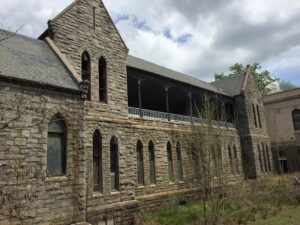
Yet this remarkable building was never intended to be a castle. Completed in 1883, it was constructed to pump water uphill to a reservoir serving Richmond’s growing population. What makes the Pump House particularly unusual, however, is that it also served as a popular social destination. Above the machinery that helped supply the city’s water, Richmonders gathered for music, dancing, and celebrations.
Although the machinery fell silent more than a century ago, the building has acquired another distinction: a reputation for being haunted.
Unfortunately, some of the Pump House’s best-known ghost stories have rather serious problems with their historical credibility. Tales of named spirits, unexplained tragedies, and extraordinary supernatural phenomena have circulated for years, often without the evidence necessary to support them.
Before exploring the building’s remarkable history and the more credible accounts of unusual experiences, it is worth examining a few of the ghosts that may never have existed at all.
When Ghost Stories Outrun the Evidence
Among those responsible for popularizing the Pump House’s paranormal reputation was Richmond-based investigator Robert Bess, whose extraordinary claims attracted considerable media attention during the late 2000s and early 2010s.
In an October 2011 Style Weekly article, Bess identified several supposed spirits occupying the building. One was a man named Daniel Tetweiler, whom Bess claimed had died by hanging at the Pump House. Others included a woman named Elizabeth, reportedly manifesting as an orb of light, and an apparition called Spectra, supposedly accompanied by numerous other spirits.
Bess went even further, suggesting that the building’s combination of water, stone, and metal allowed it to function as a supernatural portal.
These were not merely accounts of someone witnessing an unexplained shadow or hearing a mysterious noise. They were remarkably specific claims presented with considerable confidence. Yet the historical evidence to support them is conspicuously absent.
Despite extensive searches of historical records and contemporary newspaper accounts, we have been unable to locate independent documentation establishing Daniel Tetweiler’s identity, his alleged death, or any connection to the Pump House. The name instead appears in paranormal accounts that repeat the same basic story, without providing a verifiable historical source.
That does not conclusively establish that no such person ever existed. Historical records are imperfect, and even thorough research can overlook important evidence. Nevertheless, the supposed tragedy appears to be a fabrication, or at the very least an unsupported assertion that has been repeated until it acquired the appearance of historical legitimacy.
The credibility of the original storyteller makes that possibility even more troubling. On October 30, 2009, Bess appeared during a live Halloween special of the Travel Channel’s Ghost Adventures, filmed at the Trans-Allegheny Lunatic Asylum in West Virginia. During the broadcast, he claimed that an unseen force had violently knocked an electromagnetic field meter from his hand. The incident was captured on camera, and the footage appeared to show Bess throwing the instrument himself.
After reviewing the recording, hosts Zak Bagans and Nick Groff publicly rejected a paranormal explanation during the November 6 follow-up program. The controversy has since been documented in coverage of the television series.
Bess disputed the criticism in a subsequent Style Weekly interview, blaming the show’s executive producer for stirring up controversy. Nevertheless, an investigator whose supposed paranormal evidence was publicly discredited by the hosts of the very program featuring him presents an obvious credibility problem.
And this is where the larger ethical issue emerges.
Paranormal research necessarily deals with experiences that can be difficult to explain or independently verify. Someone reporting an unexplained voice, an unusual shadow, or the sensation of being watched is describing an experience. Such accounts can be recorded, considered, and investigated without assuming that a supernatural explanation has been established.
Claiming that a particular person died by suicide at a particular location, however, is an entirely different matter. That is a historical assertion, and historical assertions require evidence. Attaching an undocumented tragedy to a historic building does not make its ghost stories more authentic. Repeating that claim across websites, articles, and tours does not transform it into historical fact. Nor does presenting a staged or misleading paranormal demonstration as genuine evidence advance anyone’s understanding of the unexplained.
The ethical consequences extend beyond misleading an audience. Invented histories can obscure genuine events, unfairly associate real people with supposed tragedies, and undermine the credibility of those conducting responsible research.
In a 2026 discussion of ethics in paranormal investigation published by Skeptical Inquirer, researcher Benjamin Radford examines the responsibilities of ghost hunters, particularly the importance of avoiding harm and recognizing how unsupported supernatural claims can affect the people and places involved. These concerns should matter to anyone presenting haunted history to the public, whether they approach the paranormal as a believer, skeptic, investigator, or storyteller.
A compelling ghost story should never require inventing a victim. Nor should an investigator’s desire for a dramatic encounter take precedence over an honest account of what occurred.
Fortunately, the Byrd Park Pump House needs neither fabricated tragedies nor sensational supernatural claims to be interesting. Its genuine history provides a remarkable story of engineering, architecture, music, dancing, and generations of Richmonders gathering beside the James River. And it is precisely that history that gives the building’s more credible ghost stories their distinctive character.
A Growing City and a Remarkable New Building
During the closing decades of the nineteenth century, Richmond was a city undergoing considerable change. Still rebuilding and redefining itself after the Civil War, the city experienced significant population growth, increasing from 51,038 residents in 1870 to 63,600 by 1880. New neighborhoods, commercial development, and expanding municipal services created mounting demands on the city’s infrastructure.
One particularly pressing concern was the water supply. As Richmond expanded into higher elevations, its existing waterworks required improvements to maintain adequate service. The New Reservoir, placed into operation in January 1876 in what would eventually become Byrd Park, helped address these needs. However, additional pumping capacity was required to move water uphill from the James River and Kanawha Canal.
Under the direction of City Engineer Colonel Wilfred Emory Cutshaw, construction began on an ambitious new Pump House in 1881.
The project was a substantial undertaking. Contemporary newspaper reports document construction contracts, engineering challenges, and debates over municipal expenditures. Built largely from locally quarried granite, the building incorporated Gothic Revival architectural features, including pointed arches, steep gables, and tall windows that were considerably more elaborate than those typically associated with industrial facilities.
The machinery entered full service on May 4, 1883, and the building was formally accepted by the city’s Water Committee later that year. According to the building’s National Register of Historic Places nomination, the pumps normally operated around the clock, stopping only when repairs, low river levels, or winter ice made interruptions necessary. The facility became an important component of Richmond’s expanding water system.
The Pump House also reflected the city’s growing architectural ambitions. In December 1884, as Richmond officials debated the plans and escalating costs of a proposed new City Hall, the Richmond Dispatch reported that Cutshaw had evaluated revised designs incorporating stone comparable in quality to that used at the New Pump House. The newspaper even compared the proposed City Hall’s architectural ornamentation with that of the Pump House.
The comparison was particularly appropriate. Richmond’s new City Hall, designed by architect Elijah E. Myers and constructed between 1886 and 1894, would become another prominent example of Victorian Gothic architecture. Both buildings employed Richmond-area granite and reflected a period when civic architecture was expected to make a lasting impression, even when its primary function was entirely practical.
Cutshaw, whose long career also included substantial work on Richmond’s streets, parks, and public buildings, evidently believed that utility and beauty could coexist. At the Pump House, he went one step further: he incorporated public entertainment directly into the building’s design.
A Ballroom Above the Waterworks
The New Pump House was constructed at the scenic Three-Mile Locks, where the canal and surrounding woodlands provided an attractive retreat from the bustle of the city.
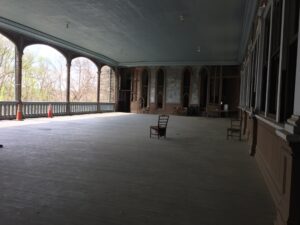
Recognizing the recreational possibilities of the location, Cutshaw incorporated a spacious open-air pavilion on the building’s upper floor. Beneath the dance floor, enormous pumps and water-powered machinery performed the more practical business of supplying Richmond with water. The result was a rather extraordinary combination: an industrial waterworks that doubled as a destination for fashionable outings and social gatherings.
Visitors could make the journey along the James River and Kanawha Canal aboard mule-drawn boats, enjoying the surrounding scenery before arriving at the Pump House. One popular vessel, the Rosebud, transported passengers from Seventh and Canal Streets to the Three-Mile Locks.
Others traveled by railroad. A July 1883 advertisement in the Richmond Dispatch promoted round-trip excursions to New Pump-House Park for just twenty cents. Departures were scheduled several evenings each week, with entertainment provided by Kessnich’s Band and a quintet of local singers. Ice cream and other refreshments were also promised.
Contemporary newspaper accounts provide delightful glimpses of the festivities that followed. In May 1886, the Richmond Dispatch reported on a German, a formal social dance, organized by young women from Church Hill. The party traveled to the Pump House by omnibus, dancing from early evening until late at night, with refreshments served around midnight.
Another account, published in July of that year, described a moonlight gathering where guests enjoyed music, dancing, and the refreshing breezes drifting through the pavilion. The newspaper also recorded picnics, dinners, and other organized outings at the popular destination.
These celebrations were part of the social world of nineteenth-century Richmond, including its racial divisions. As The Valentine’s history of the Pump House explains, the canal excursions and dances catered to white Richmond society during an era of segregation. Nevertheless, the building’s popularity as a recreational destination was remarkable, particularly considering its industrial purpose.
As the years passed, improvements were made to accommodate visitors. Electric lighting was installed in 1898, and the following year the previously open pavilion was enclosed with woodwork and decorative glass. The alterations helped make gatherings possible throughout the year while also addressing an unfortunate engineering problem: rainwater had been leaking through the pavilion floor onto the machinery below.
For decades, the Pump House served two very different purposes. While its machinery worked to sustain the growing city, its upper floor provided a place to escape the ordinary routines of daily life. The building was filled with conversation, footsteps, music, and laughter. And according to some modern accounts, traces of that lively atmosphere may still linger.
When the Pumps Went Quiet
By the early twentieth century, Richmond’s water system was undergoing another transformation. New technology and changing municipal needs gradually rendered the nineteenth-century Pump House obsolete. In September 1924, a modern hydroelectric pumping station entered service beside the older building, replacing it as the principal facility for moving water to the Byrd Park Reservoir.
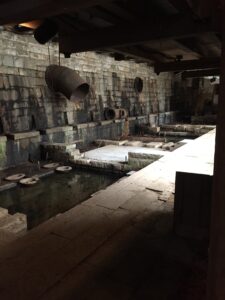
The original pumps were permanently retired, and much of the machinery was eventually dismantled and sold for scrap before World War II.
The precise date of the last social gathering in the original pavilion remains uncertain. Although the building’s industrial function ended in 1924, its history as a gathering place cannot be assigned such a definite conclusion. In fact, the National Register nomination specifically acknowledges that no record had been found establishing when the pavilion hosted its final event.
What is certain is that the once-celebrated building gradually fell into neglect. Without a permanent new purpose, the Pump House suffered from vandalism, deteriorating woodwork, water damage, and years of exposure to the elements.
By the 1950s, demolition had become a very real possibility. The city ultimately sold the property to First Presbyterian Church for one dollar, temporarily sparing it from destruction. Ownership later returned to the City of Richmond.
Despite its declining condition, the Pump House retained much of its architectural character. Its unusual design attracted the attention of historians, photographers, and preservation advocates. The Library of Congress’s Historic American Engineering Record preserves detailed photographs and architectural documentation of the building, while its listing on the National Register of Historic Places in 2002 formally recognized its historical and architectural significance.
And somewhere along the way, the old Pump House developed another kind of reputation.
When the Music Never Quite Stopped
While many of Richmond’s ghost stories involve accounts of tragedy, violence, or untimely deaths, the supernatural traditions surrounding the Pump House seem to have a considerably more cheerful character. Over the years, visitors, volunteers, and paranormal enthusiasts have described unexplained voices, shadows, and other unusual experiences within the building. Some of these accounts seem particularly suggestive of the activities that once filled its rooms.
Among the earlier published investigations was one conducted by Richmond author and paranormal researcher Beth Brown. In a July 2008 article titled “Legends Set in Stone,” Brown described experiences reportedly shared by individuals involved in the Pump House’s preservation.
One account came from Michael Gee, an intern who had been working upstairs with a companion when they heard what sounded like a conversation in the machinery room below. Assuming someone had entered the building, Gee went downstairs to investigate. As he approached the bottom of the stairs, he reported that his flashlight went out and the voices stopped. When he retreated up the stairs, the light returned and the voices apparently resumed. After repeating the experience, he decided that his workday had lasted quite long enough.
Another volunteer, Chris Knoop, reportedly heard sounds resembling other workers moving about the machinery room while he was alone in the building. Rather than fleeing, Knoop apparently continued his work, concluding that whoever, or whatever, was making the noises seemed content to do the same.
Brown also described reports from visitors who claimed to have heard conversations and faint music coming from the otherwise closed building. Intrigued by these accounts, Brown conducted her own investigation with two companions. The group explored the building, recorded audio, and attempted to determine whether ordinary voices outside could account for some of the reported sounds. Their recordings contained two curious anomalies: a faint voice that appeared to respond to a comment and a brief sequence of notes resembling music.
Yet Brown did not claim to have established that the Pump House was haunted. She characterized the results of the investigation as inconclusive, acknowledging that the recordings and photographs provided no definitive proof of supernatural activity. That distinction is important. Unexplained sounds are not automatically evidence of spirits, and an unusual recording does not become paranormal simply because its source is uncertain. Nevertheless, Brown’s account provides a useful record of the types of experiences people were reporting at the Pump House, without requiring the invention of specific ghosts or tragic histories.
Similar reports have continued into the present day. In an October 2026 interview with CBS 6, Haunts of Richmond storyteller Tiffany Jones described the Pump House as a particularly active location.
“We’ve seen shadows,” she explained. “We’ve noticed playing music of that time period will get them going.”
It is an intriguing observation, particularly considering the building’s documented history of dances, parties, and musical entertainment. Of course, not everyone who spends time in the building has experienced anything unusual. The volunteers of Friends of Pump House, who have devoted countless hours to its preservation, state that they have not personally encountered convincing paranormal activity or found historical evidence supporting the more sensational ghost stories. That perspective deserves consideration alongside the experiences reported by other visitors.
Whether the Pump House is genuinely haunted remains an open question. Old buildings can produce unfamiliar noises, light behaves unpredictably in dark spaces, and expectations can influence how ambiguous experiences are interpreted. Nevertheless, there is something particularly appealing about the Pump House’s supernatural reputation. Rather than a tortured spirit seeking justice or a mysterious apparition guarding a hidden tragedy, its reported hauntings suggest something altogether more cheerful: the possibility that some of Richmond’s nineteenth-century revelers simply aren’t ready for the party to end.
Preserving the Past, One Investigation at a Time
Whatever the explanation for its reported paranormal activity, the Pump House’s ghostly reputation has produced at least one very real benefit: helping to support the building’s preservation. Paranormal investigations and ghost-themed gatherings have taken place at the property for many years. Transcend Paranormal, a Richmond-area paranormal investigation organization, has helped transform public interest in the unexplained into tangible support for the building’s future.
The organization has hosted public investigations at the Pump House, allowing participants to explore the historic structure while learning about the equipment and methods used in paranormal investigations. Events held in 2024, 2025, and 2026 directed their proceeds toward the building’s preservation. These efforts benefit Friends of Pump House, a volunteer-led organization established in 2017 to protect and restore the historic landmark.
Working alongside the City of Richmond, preservation organizations, and community supporters, Friends of Pump House has helped sustain interest in the building’s future. Its members organize educational tours, volunteer workdays, special events, fundraising initiatives, and ongoing advocacy. Their efforts have supported important improvements, including the restoration of historic windows and doors, repairs to deteriorating architectural features, and work to protect the building from further water damage. The organization’s long-term vision is to see the Pump House restored to a condition where it can once again serve as a gathering place for Richmonders.
That aspiration has a particularly satisfying historical symmetry. More than a century ago, Cutshaw imagined a municipal waterworks that could also provide entertainment and enjoyment to the public. Today, the same building’s unusual history, remarkable architecture, and paranormal reputation are bringing people together to ensure that it survives.
Transcend Paranormal’s fundraising investigations offer an example of how interest in ghost stories can serve a constructive purpose, regardless of whether anyone ever establishes that a ghost is actually present.
And the continued dedication of Friends of Pump House demonstrates that the most important work taking place within its walls has little to do with the supernatural.
There may or may not be ghosts in the old ballroom, but there are certainly people working to give it a future.
A Building That Still Has Stories to Tell
More than 140 years after its opening, the Byrd Park Pump House remains one of Richmond’s most distinctive historic landmarks. It is a reminder of an era when the city’s leaders combined ambitious engineering with elaborate architecture, and when a public utility building could also become a destination for music and celebration. Its story has evolved over time, from a vital component of the municipal water system to a popular entertainment venue, an abandoned architectural treasure, and eventually a place associated with unexplained experiences.
It also offers an important lesson about the responsibility that comes with telling ghost stories. The genuine history of a place should never be treated as an inconvenience to be embellished or discarded when something more sensational comes along. Nor should questionable claims be repeated simply because they have become familiar parts of local folklore. The Pump House’s history deserves better than that.
Fortunately, its documented past is already rich with the sort of human experiences that make ghost stories compelling: ambition, hard work, celebration, changing fortunes, and the passage of generations.
Whether the shadows reported within its walls belong to something supernatural or simply to the imagination of those drawn to its extraordinary atmosphere, the Pump House continues to inspire curiosity. And perhaps, somewhere above the long-silent machinery, the next dance is merely waiting for the music to begin.
Historical Sources and Further Reading
Architectural and Historical Research
National Register of Historic Places — New Pump-House Nomination (2002)
Virginia Department of Historic Resources — New Pump-House
Library of Congress — Historic American Engineering Record, New Pump-House
Library of Virginia — Old City Hall
The Valentine — Building a City: Byrd Park Pump House
Historic Richmond — Byrd Park Pump House
Contemporary Newspaper Accounts
Richmond Dispatch, February 12, 1881 — Pump House Construction Contracts
Richmond Dispatch, July 11, 1883 — New Pump-House Park Excursions
Richmond Dispatch, November 17, 1883 — Water Committee Acceptance
Richmond Dispatch, December 17, 1884 — Plans for the New City Hall
Richmond Dispatch, May 23, 1886 — German at the Pump-House
Richmond Dispatch, July 18, 1886 — New Pump-House Picnics
Paranormal Accounts and Research Ethics
Beth Brown — “Legends Set in Stone” (2008)
Style Weekly — “The 13 Most Haunted Places in Richmond” (2011)
Style Weekly — “Ghost Adventurer” (2011)
Looper — “The Untold Truth of Ghost Adventures”
Benjamin Radford — “Ethical Issues in Ghost Investigation,” Skeptical Inquirer (2026)
WTVR CBS 6 — Richmond’s Haunted History (2026)
